Introduction
NMS stations communicate with the ZigBee protocol in the 2.4 Ghz frequency. Although this frequency is also used by WiFi, it is designed to have minimal interference. It uses smaller frequency bands, which enable to work more robust and attain a longer range than what could be achieved with wiFi. ZigBee networks are designed for robustness in mind. It supports meshing networks, which means that every NMS station extends the coverage area. Which this principle to is possible to cover a large area, e.g. an innercity or event location. There are real-life examples which gives you an idea what can be possible.
The standard setup is shown below. In optimal circumstances the range between a gateway and a NMS station can be up to 400 meter, with the supplied antenna's. The actual range achieved depends on the local circumstances, like RF noise level. In A city the RF noise level is normally higher which decreases the range, while in the country side the noise is in general lower which extend the range.
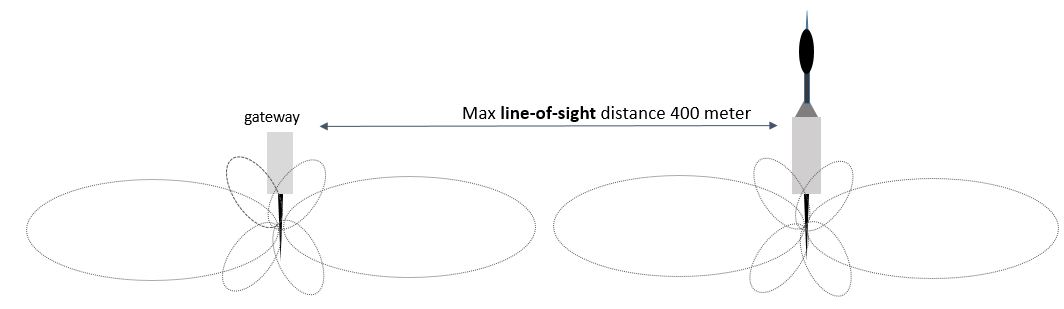
Making use of the meshing capability
As said, the ZigBee standard supports meshing. With this capability it is possible to extend the range by placing more NMS stations. Below is a picture where four NMS stations are installed with one gateway. Some NMS stations are to far away from the gateway and will route their data via other NMS stations, which can see (in RF terms) the Gateway. Zigbee supports hundreds on nodes, but for NMS's it should be limited to around ten NMS stations per gateway. In a Zigbee network only one NMS can use audio streaming at the time and should by preference have a direct connection to the gateway.
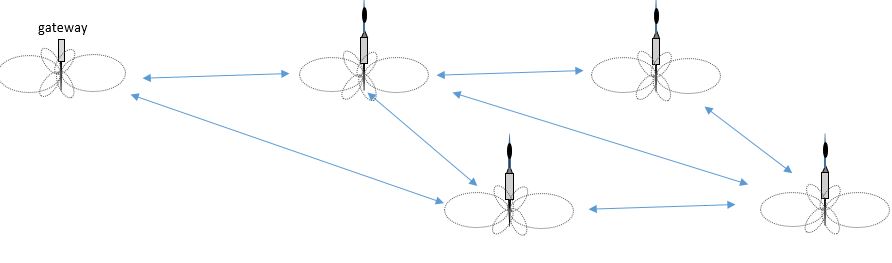
Some considerations:
- If you plan coverage in a city area and permanent installation, try to find a high location for the gateway, perferable a rooftop.
- In a large configuration is is recommended to change the antenna of th egateway for an OMNI antenne with an higher Gain.
The rule of thumbs to install it right
1. Ensure that the antenne's are al positioned vertical en point downwards.
The antennes are vertical polarized and radiate a parabolic RF pattern (see below). Downwards pointing reduces the change that water penetrate into the antenne.
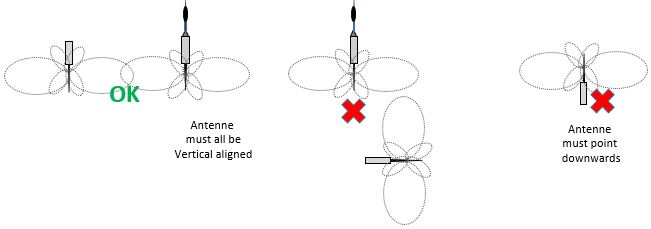
2) Ensure that the antenneconnector is protected from rain.
When the antenne is screwed onto the device, one should use volcanic tape around the connector to protect it from water penetration into the antenna. Water will cause a short circuit of the antenne and dramatically reduce the working. When it is properly taped it should look like below
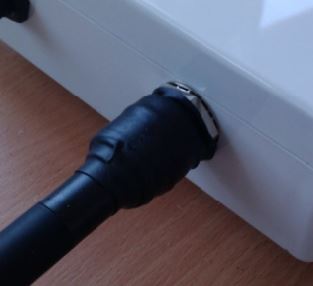
3) avoid placing the NMS close to ground.
NMS stations are best positioned at an height of 4 to 5 meter. This ensures that the RF connection is not disturbed by walking people or vehicles.
4) Avoid placing de device close to a WiFi access point working in the 2,4 GHz band.
Although Zigbee and WiFi devices can share perfectly the 2,4 GHz band. It is better no to position close to each other. A distance of at least 2 meters is a good practice.
Extending the range
If the range is insufficient there are two ways to extend the range.
1) Use intermediate NMS stations or zigbee routers.
In this case you make use of the meshing capability of zigbee. An intermediate node can double the distance, but of course have the drawback of finding and installing an intermediate node, which possible needs attention.
2) Using directional antenna's
The NMS and gateway are supplied with standard low gain OMNI directional antenna's. This is suitable in most cases and are optimized for mesh networking. But if you know to place of the Gateway and on y have to communicate with one or two NMS stations in the same directions as seen from the gateway, you could consider using directional antennas with an higher gain. It is than perfectly possible to increase the range by two or three fold. An example is shown below.
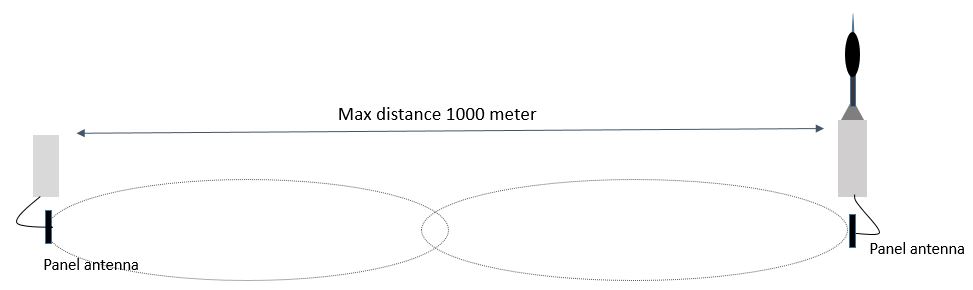
Some considerations:
- With extending the range is is good to place the gateway higher, to avoid reduction of the range due to the fresnelzone reaching the ground. Placing the gateway on a rooftop or higher than 5 meter is recommended.
- There could be local regulations which limit the use of directional antenna's with a high gain. These are country specific.
- In general you can use outdoor antennes used for Wifi to extend the range,
0 Comments